
How to Verify a Chinese Refrigerated Truck Manufacturer
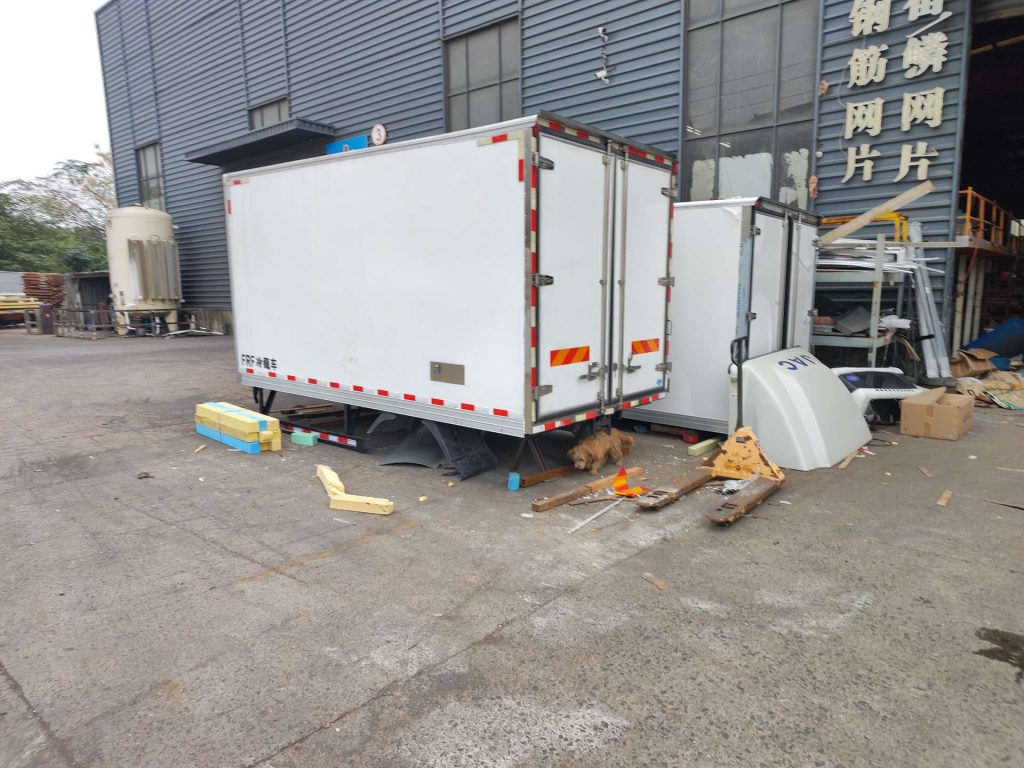
Most buyers who get burned when importing a refrigerated truck from China do not lose money because the truck is badly built. They lose it because they were never talking to a factory. A trading office with a rented desk and a borrowed photo album will happily quote you a price, take a deposit, and then buy from whichever plant answers the phone cheapest that week — and the moment something goes wrong, that company has nothing to lose locally and no incentive to fix it.
This article is a working checklist. Every step below uses a public Chinese database or a document you can request by email, and none of it requires you to fly to China first. We have written it the same way we would explain it to a buyer sitting in our own meeting room — including the parts that do not flatter us.
Step 1: Ask for the announcement model code, and check it yourself
China does not allow anyone to build and sell a road vehicle freely. Every model must appear in the Announcement of Road Motor Vehicle Manufacturers and Products issued by the Ministry of Industry and Information Technology (MIIT), and a body builder that turns a chassis into a refrigerated truck is treated as a vehicle manufacturer in its own right.
For an overseas buyer the announcement number is the single most useful check available, because it cannot be bought: it is issued to a named legal entity at a named address, and the model is tied to that entity. A refrigerated model carries XLC in its code, and the digits before it indicate the gross weight class — so a quotation claiming 5 tonnes GVW against a code that says 03 deserves a second email.
Ask for the code, the announcement batch number and the date, then confirm the same model in the MIIT public query system. We explain how to read the code, digit by digit, in a separate article — it is worth ten minutes before you go any further. If a supplier answers with a brand name and a photo album instead of a code, you already have your answer.
Step 2: Check that the CCC certificate covers the model you are buying
China Compulsory Certification (CCC) is the product certification scheme that covers, among other things, complete motor vehicles. A CCC certificate is issued against a scope — a list of models — and this is where a lot of overseas buyers get caught, because “we have CCC” and “the model you ordered is on our CCC certificate” are different statements.
Our own position, stated plainly so you can hold us to it: we hold 20 CCC certificates covering 36 announced models, of which 4 certificates cover 17 refrigerated truck models. The certificates are issued by the China Certification Centre for Automotive Products (CCAP) and are valid between 2027 and 2031. Certificates can be checked against the certificate number on the national certification and accreditation public service platform, and we will send the certificate PDF and its annex for whichever model you are considering.
Three things to insist on:
- The certificate annex, not just the cover page. The annex is what lists models. A cover page proves the company has a certificate; the annex proves the certificate covers your model.
- The certificate holder name. It should be the manufacturer you believe you are buying from, not an affiliate, a sister company or a distributor. If the names differ, ask for the relationship in writing.
- Validity dates against your shipping schedule. A certificate expiring before your build is not a problem for us — it is a problem for your customs broker, who will be looking at the document you present.
Note the honest limits. CCC is a Chinese scheme. It tells you the vehicle met Chinese requirements; it does not tell you it meets your country’s requirements. Markets such as Nigeria, Kenya, Tanzania and the GCC states apply their own conformity programmes, and the importer is normally the party obliged to clear them. A supplier who tells you “CCC is enough for your country” is either guessing or selling.
The models we hold certificates for are listed with certificate numbers and validity dates on the certifications page.
Step 3: Read the business licence scope carefully
Chinese business licences list a scope of business, and the wording matters. A company licensed for vehicle manufacturing (车辆制造) or vehicle modification (车辆改装) is a production entity. A company licensed for vehicle sales (汽车销售) and nothing else is a dealer, which is a perfectly legitimate business — but it is not a factory, and it cannot hold a vehicle announcement in its own name.
Ask for:
- Business licence scan, with the scope visible in full (not cropped to the header).
- Unified Social Credit Code, and a check that it matches the name on the announcement and on the CCC certificate.
- The registered address, and whether the plant address in the factory video matches it. Factories that modify vehicles need a real yard; a serviced office address is a warning sign.
For transparency: our scope includes vehicle modification and special-purpose vehicle production, and also includes Class II medical device sales as a general item. That last item is a trading qualification. It is relevant to selling a refrigerated body to a medical logistics customer; it is not a pharmaceutical certification, and we do not present it as one.
Step 4: Request the export document set before you pay a deposit
The documents you will need at destination are predictable. Ask for a sample of each now, from a previous shipment with the customer’s commercial data removed. What you receive tells you whether the supplier has actually exported before.
| Document | What it proves | Common failure |
|---|---|---|
| Commercial invoice & packing list | Shipment is properly described | Model described loosely, e.g. “truck parts”, which creates problems at destination valuation |
| Bill of lading | Cargo was actually shipped | Booked as break-bulk when the box was designed for a flat rack |
| Certificate of origin | Origin, and duty treatment where a trade agreement applies | Origin issued on the trading company rather than the manufacturer |
| CCC certificate copy | Chinese conformity | Cover page only, annex missing |
| Chassis CoC / chassis documents | The donor chassis is a genuine, traceable unit | Chassis sourced grey-market, no traceable document set |
| Vehicle announcement page | The model is legally built | Screenshot without batch number, impossible to verify |
We do not quote duty rates or destination clearance fees, because they change and because they depend on your HS classification and your broker. What we can do is supply the document set above and answer technical questions from your broker directly.
What a useful pre-shipment photo set contains, and how to read it, is set out in pre-shipment inspection photos.
Step 5: Test the factory with questions only a factory can answer
Photos are cheap. Questions are not. The following are hard to answer convincingly if you are a trading office:
- Where do the panels come from? Ask whether the insulated panels are produced in-house or bought in. Both are legitimate, but the answer changes the lead time and the warranty path. We laminate our own FRP-skinned PU panels; a supplier who buys panels will have less control over foam density and panel flatness.
- What is the actual panel build-up? Thickness is only one number. Ask for skin material and thickness, foam density, and the frame and joint detail. “100 mm PU” means very little on its own.
- Who mounts the refrigeration unit? A unit mounted by the body builder can be warrantied as one system. A unit mounted by a third party after delivery splits responsibility — ask which arrangement you are buying.
- What is the certification of the refrigeration unit itself? The unit is a separate product with its own documentation. Ask for the model, the cooling capacity at your ambient condition, and the unit manufacturer’s data sheet.
- Can we see the model on the line? A live video call from the shop floor, unscripted, at a time you choose. This is the cheapest factory audit in existence and very few trading offices will agree to it twice.
Red flags worth walking away from
- No announcement model code, or a code without the correct function letters.
- CCC mentioned as a company attribute rather than a model list.
- Price quoted far below the chassis cost alone. A refrigerated truck cannot cost less than its chassis plus a body.
- Spec sheet that copies another manufacturer’s model designation, including that manufacturer’s chassis code.
- Payment only to a personal account, or a company name that changes between the quotation and the proforma invoice.
- Refusal to name the chassis model and year, or to state whether the chassis is current production.
- Photographs whose location metadata or background does not match the claimed plant, used repeatedly for different models.
- Delivery promises that ignore Chinese New Year, chassis allocation lead time, or the certification timeline.
What this checklist cannot tell you
Announcements, certificates and licences prove a company is legal and that a model exists. They do not prove build quality, they do not prove that your specific configuration has ever been built before, and they do not transfer any approval to your market. Those questions are answered by a factory visit, a pre-shipment inspection, or a paid sample build — and a supplier who tells you otherwise is overselling the paperwork.
If you are at the stage of shortlisting suppliers, send us the model code you have been quoted and we will tell you what the public record says about it, including when the answer is not in our favour.
Frequently asked questions
Can I verify a Chinese supplier without visiting China?
Yes, for the legal and certification layer. Announcement numbers, CCC certificate annexes, business licence scope and credit codes are all checkable remotely. Build quality and production capability are not, and that gap is what a pre-shipment inspection or a factory video call is for.
Is CCC the same as a certificate of conformity for my country?
No. CCC is a Chinese compulsory certification. Your market may require its own conformity assessment, and the obligation usually sits with the importer. Treat CCC as evidence that the vehicle was legally built in China, not as a passport into your market.
Why does the model code matter more than the specification sheet?
Because the code is public and issued by a regulator, while the specification sheet is written by whoever is selling to you. The code can be checked by a third party; the sheet cannot.
What if my supplier is a trading company but the factory is real?
That can work, provided the factory is named, the announcement and CCC holder is the factory, and the trading company’s role and margin are transparent. The arrangement becomes risky when the factory is never named, because you cannot verify anything and you have no route to the manufacturer if a warranty issue appears two years later.