
Why RHD Refrigerated Trucks Are Hard to Source from China
Why right-hand-drive refrigerated trucks are scarce from Chinese builders, what really changes between LHD and RHD, and four sourcing routes that work.
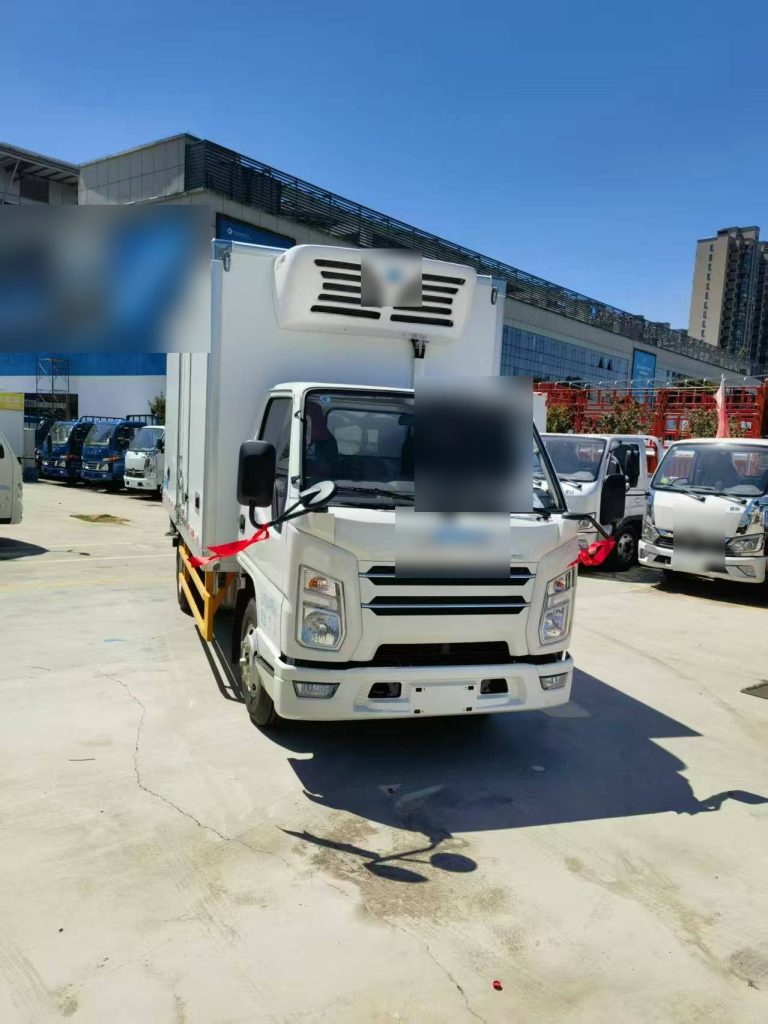
Almost every importer in Nairobi, Dar es Salaam, Kampala or Johannesburg asks the same question in the first two emails: can you supply right-hand drive? For a Chinese body builder the honest answer is usually “the body, yes; the complete vehicle, only in specific cases”. This article explains why that is, what genuinely changes between a left-hand-drive (LHD) and a right-hand-drive (RHD) refrigerated truck, and the four sourcing routes that actually work in practice.
The short answer: the body is not the problem
A refrigerated body — insulated panels, floor, rear door, side door, refrigeration unit, interior lighting — is essentially side-agnostic. Nothing inside the box cares which side the driver sits on. What does have a handedness is the chassis: steering gear and column, dashboard, pedal box, wiring loom, wiper sweep, mirror arms, headlamp beam pattern and the cab door hardware.
So the RHD question is really a chassis question. And in China, the chassis market is overwhelmingly left-hand drive.
Why almost every Chinese truck is left-hand drive
China drives on the right. Domestic demand for RHD vehicles is limited almost entirely to export orders, which has three practical consequences for a buyer:
- Homologation follows the domestic market. A model is developed, tested and announced for sale inside China first. An RHD variant is a separate development programme with its own tooling, validation and cost — it does not come free with the LHD version.
- Volume is fragmented. RHD orders are spread across many markets with different regulations, so a single RHD variant rarely accumulates the volume that justifies a new dashboard, pedal box and steering column.
- Availability is model-level, not brand-level. A chassis family that had an RHD export version two years ago may not have one today. Any statement about RHD availability has to be checked against the specific model and the current model year, not against the brand’s reputation.
What actually changes between LHD and RHD
This is the part worth reading carefully, because it decides whether your project is simple or expensive.
| Item | Changes with RHD? | Why it matters for a reefer build |
|---|---|---|
| Steering gear, column, pedal box | Yes | Chassis-side; affects the frame area at the cab floor and any under-cab equipment you want to fit |
| Dashboard and interior trim | Yes | Packaging space for body wiring and unit controls is mirrored |
| Wiring loom | Yes | The cab-to-body interface (compressor engagement, evaporator control, warning lamps) is routed on the other side |
| Wiper sweep, mirror arms | Yes | Mirror arm side changes the vehicle’s overall width — relevant to your body width and to container loading |
| Headlamps | Yes | Beam pattern is asymmetric. An LHD lamp unit is the wrong beam for an RHD market and can fail conformity inspection |
| Body side door position | Optional | In left-hand-traffic countries the kerb is on the left. Specify the side door on the kerbside and the loading workflow matches the street |
| Body structure, insulation, floor, rear door, refrigeration unit | No | The box itself is the same design on either chassis — this is why body-only supply works |
The certification layer most buyers miss
China’s CCC certification and the MIIT announcement system govern vehicles sold inside China. An export unit is not sold in China, so a domestic CCC certificate is not what gets it registered abroad. What the buyer actually needs is destination conformity — for example pre-export verification of conformity (PVoC) in Kenya and Tanzania, PVoC with the national bureau of standards in Uganda, or a Letter of Authorization from the NRCS in South Africa, with SABS marking where applicable.
Requirements change and vary by vehicle category, so confirm the current rule set with your clearing agent before you commit a build. One point we can state plainly: an RHD body we build does not inherit any Chinese type approval for the complete vehicle. The chassis supplier’s approval and the destination regime carry that, which is exactly why route A below is usually the cleanest path.
Whether a China VI unit is accepted in your market is covered in China VI and export compatibility.
Four sourcing routes, ranked by what usually works
| Route | How it works | Strength | Watch out |
|---|---|---|---|
| A. Body-only on a locally supplied RHD chassis (recommended for most LHT markets) | You buy an RHD chassis locally or regionally — Isuzu NKR/NPR, Hino 300, Toyota Dyna and Fuso Canter RHD variants are common in right-hand-traffic Africa — and either ship it to us or send us its drawings; we build the body to that chassis | No complete-vehicle homologation risk on our side; local parts and service network; duty on a body is usually lower than on a complete vehicle | Needs accurate chassis drawings; frame reinforcement and mounting points differ by model and by rear-axle specification |
| B. Complete vehicle on a Chinese RHD chassis, where one exists | A number of Chinese OEMs build RHD export variants of light and medium trucks; we can quote on that basis subject to engineering review of the specific model | One supplier, one shipment, one point of responsibility for the build | Availability is model-specific and can change between model years; destination conformity still sits with the importer |
| C. Complete RHD vehicle from a maker already homologated in your market | Buy a complete unit from a brand with existing market approval and specify the body with us only if the supply chain allows | Fastest route to registration | Highest unit price; body specification is often fixed by the OEM |
| D. Converting an LHD vehicle to RHD | Not recommended | — | Steering geometry, wiring, dashboard, wipers and headlamps all change; the OEM warranty is normally void and conformity is very hard to obtain. Do not budget this as the cheap option |
Route A in detail: what a body-only RHD project looks like
The sequence is the same as any body project, with two extra documents at the front:
The commercial difference between shipping a body and shipping a complete vehicle is compared in refrigerated body or complete truck.
- Chassis identification. Model and model year, wheelbase, frame width and section height, cab-to-axle dimension, rear overhang, rear axle rating.
- Interface decisions. Refrigeration unit position (roof, nose-mount or under-mount), compressor drive (engine PTO, auxiliary engine or electric standby), alternator output, and condenser clearance in front of the radiator.
- Body specification. Internal length, width and height; panel thickness (50, 75 or 100 mm); floor type and load rating; rear and side door configuration including which side the kerbside door goes; interior fittings such as meat rails or shelving.
- Shop drawings for approval before any panel is cut.
- Delivery. Either a body kit in a container, or a finished body fitted to the chassis if you ship the chassis to us — the container loading side of this is covered in our container loading guide.
What we can and cannot claim
We can build refrigerated bodies to your RHD chassis drawings, in 50, 75 or 100 mm insulated panels, with the door side and unit position set for left-hand traffic, and supply the body documentation your agent will ask for. Bodies are covered by our CCC certificates as body/vehicle products for the domestic range — the certificate set is on our certifications page.
We cannot offer an RHD complete-vehicle type approval for any model, and we will not say we can in order to win an order. If your market requires an approved complete vehicle, routes B or C are the honest answer.
Questions we get asked
Is a body for an RHD chassis more expensive? The body itself is not. What changes is engineering time for the interface drawings, plus any change of door side or unit position you specify.
Can you fit the body to a chassis we ship to you? Yes, subject to an engineering review of the frame and cab — this is a normal route for RHD projects.
Do we need CCC for an export unit? CCC governs sale inside China. Your gate is destination conformity, not a Chinese certificate. Confirm the current requirement with your clearing agent before ordering.
This article is general guidance for importers, not regulatory advice for a specific market. Vehicle regulations change; verify current requirements with your own agent before committing a build.
Zhejiang Miao Sheng Automobile Co., Ltd. builds refrigerated truck bodies, insulated bodies and specialist vehicles, quoted by MIIT announcement model with the documentation buyers need for registration. Final specifications follow the confirmed build sheet and chassis drawings before ordering.
Next step: tell us the chassis you intend to use and the route it will run — start at refrigerated trucks for Africa, the truck bodies range, or go straight to the Contact page.