
Shipping a Refrigerated Truck from China to Africa: RoRo or Container
Container or RoRo, the documents your destination authority will ask for, Incoterms and the timeline for a reefer truck shipment from China to Africa.
Why the shipping decision comes before the purchase order
Most first-time importers spend weeks comparing truck specifications and about twenty minutes deciding how the unit will actually reach their yard. That order is backwards. On a light-duty refrigerated truck the freight component is usually the second-largest line in the landed cost, and on a heavy chassis it can be the difference between a project that works and one that does not. Worse, a truck that has been built to the wrong transport envelope cannot be fixed at the port.
This guide covers the mechanics of moving a refrigerated truck from a Chinese factory to an African port: which units travel in a container and which cannot, what documents the destination authority will ask for, how the timeline is actually sequenced, and the four mistakes that generate demurrage bills.
Container or RoRo: the physical limit decides, not the price
There are two practical methods for a complete vehicle, plus break-bulk for oversize units. The choice is not a preference — it is settled by the dimensions of the truck.
When a container works
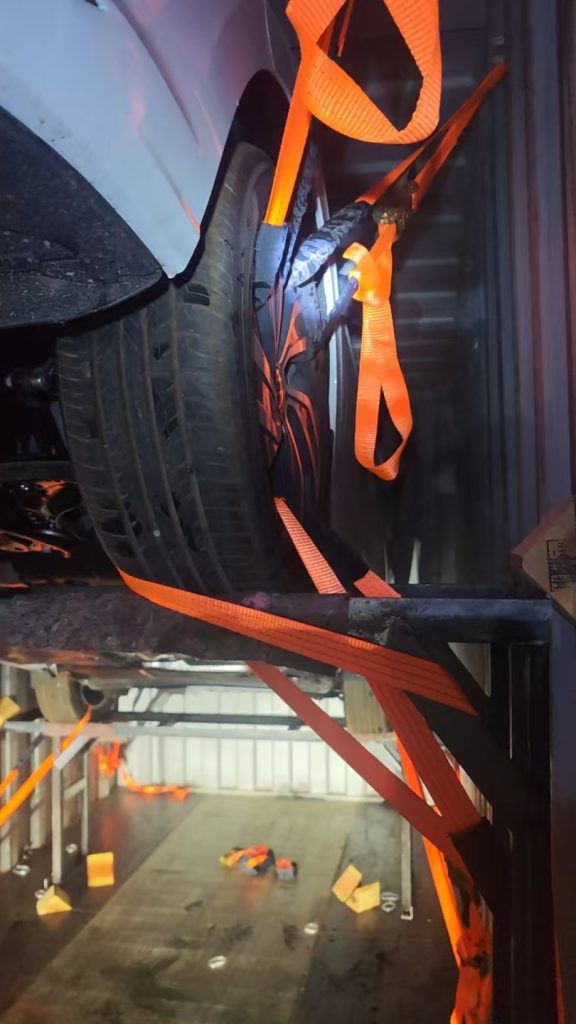
A light-duty refrigerated truck — the 3.5 t to 5 t class built on a Foton, JMC or Isuzu Class II chassis, with a 3 m to 4.2 m insulated body — fits inside a 40HQ container once the mirrors are folded and the unit is positioned correctly. Interior length of a 40HQ is roughly 12.03 m and width 2.35 m, so a single unit occupies part of the floor and the remainder is normally filled with body panels, spare parts or a second small unit where the dimensions allow. Loading is by crane or by ramp, and the container is sealed at the factory.
The advantages are real: the cargo is not visible, handling damage risk is lower, the container can be stuffed at our yard rather than at a port warehouse, and the sailing schedule is far denser than RoRo. The constraint is height. A high-body reefer with a tall refrigeration unit on the roof can exceed the internal height of a standard container, and that is measured before production, not after.
When RoRo is the only option
Heavy-duty reefers — 6×4 tractor units, 8×4 chassis, anything with a body above roughly 2.6 m external height, or a unit with a roof-mounted refrigeration pack — travel as rolling cargo. The truck is driven onto the vessel, lashed, and driven off at destination. There is no container, no stuffing, no lifting.
RoRo restricts you to ports with a RoRo berth and a scheduled service. In Africa the practical gateways are Dar es Salaam, Mombasa, Lagos (Tin Can and Apapa), Tema, Abidjan, Durban and Djibouti, with coverage varying by carrier and season. If your destination is inland — Kampala, Kigali, Lusaka, Harare — you are also choosing a transit corridor when you choose the port, and the transit leg is a separate cost from the ocean leg.
If you are weighing a knocked-down shipment against a complete unit, the volume, duty and assembly comparison is set out in CKD or complete unit.
The documents that decide whether your truck clears
Freight forwarders handle the sea leg. The documents are where importers get stuck, because several of them can only be produced by the exporter and only before the vessel sails.
| Document | Who issues it | Why it matters |
|---|---|---|
| Commercial invoice and packing list | Exporter | Basis for duty assessment and for the inspection file; must match the bill of lading exactly |
| Bill of lading | Carrier | Title document; the consignee field decides who can clear the cargo |
| Certificate of origin | CCPIT or the issuing authority in China | Required by most customs authorities; also the basis for any preferential tariff claim |
| Certificate of conformity (CoC) | Exporter, on the basis of the chassis manufacturer’s documentation | Confirms the unit matches the homologated specification; requested by customs and by the destination standards body |
| Pre-shipment conformity certificate (PVoC / SONCAP and equivalents) | Accredited inspection body in the destination country | Mandatory for a growing list of African markets before the cargo arrives; cannot be obtained retroactively at the port |
| Marine insurance certificate | Insurer | Required under CIF; strongly advised even under FOB and CFR |
Two points deserve emphasis. First, pre-shipment verification regimes differ by country and change without much notice — Nigeria’s SONCAP, Kenya’s and Tanzania’s PVoC, and the equivalent schemes elsewhere each have their own route and their own accepted standards. Confirm the current requirement for your destination before the unit is booked, because an inspection that has to happen after loading usually means the container waits. Second, the certificate of conformity reflects the chassis manufacturer’s homologation, not a promise that the vehicle satisfies your country’s registration rules. Registration compliance is the importer’s obligation and is assessed at home.
Country-specific document sequences are set out separately for Nigeria, Kenya and Tanzania.
How the timeline actually sequences
- Specification lock. Chassis model, body length, panel thickness, refrigeration unit, door configuration. This is also when you fix the transport envelope: overall height with the refrigeration unit fitted, and whether the unit is container-loadable.
- Chassis availability. The single most common source of delay. The body is built by us; the chassis comes from Foton, JMC, Isuzu or another manufacturer and is ordered against the specification. Lead time is quoted per order because it depends on the model, not on our workshop capacity.
- Body build and refrigeration installation. Insulated panel fabrication, assembly, door and hardware fitting, refrigeration unit mounting and commissioning.
- Pre-shipment inspection. Where the destination requires third-party verification, this happens at the factory or at a designated facility before the unit is moved to the port.
- Inland transport and booking. Factory to the loading port, container stuffing or RoRo terminal acceptance, vessel booking. Cut-off dates for documentation are earlier than the sailing date, sometimes by a week.
- Ocean leg. Schedules vary widely by corridor and by carrier; ask your forwarder for the current transit time on the specific port pair rather than a general figure.
- Destination clearance and inland transit. Duty and VAT assessment, inspection, release, then the road leg to your site.
Incoterms: what you are actually buying
FOB means the exporter’s responsibility ends when the cargo is on board at the Chinese port. CFR adds the ocean freight. CIF adds marine insurance on top of CFR. None of the three includes destination clearance, duty, VAT, port charges at destination or the inland leg — and those are frequently larger than importers expect on a first shipment.
A practical recommendation for a first order: buy CIF, and separately obtain a written quote from a destination-side clearing agent before you place the order. The clearing quote is what turns an ocean freight figure into a landed cost. Importers who skip this step discover the gap only when the container is already at anchor.
Four mistakes that generate avoidable cost
1. Booking the freight before the dimensions are fixed. A refrigeration unit added after the freight quote changes the height, and a height change can move the shipment from container to RoRo.
2. Assuming every African port takes RoRo. Several major container terminals have no RoRo berth, and the nearest alternative may add a thousand kilometres of road transit.
3. Leaving the conformity inspection until after loading. PVoC and SONCAP are pre-shipment regimes by design. Once the cargo has sailed without the certificate, the importer is negotiating from the weakest possible position.
4. Ignoring destination age and emission rules for used or new commercial vehicles. Several markets restrict the age of imported commercial vehicles or apply emission requirements that differ from China VI. Check the current rule for your country and, where a restriction exists, confirm it against the chassis model before production rather than at the port.
What we prepare before the container is sealed
Every unit leaves our yard with the refrigeration unit commissioned and run-tested, the body checked for panel alignment and door sealing, the battery isolated, fuel drained to the level the carrier requires, and a photographic record of the loading. Where the destination requires pre-shipment verification, the inspection is completed before the unit moves to the port. Documentation is issued against the final specification, so the invoice, the packing list and the certificate of conformity describe the same vehicle.
If you are at the stage of comparing transport options for a specific route, send us the destination port, the chassis class and the body length. We will tell you which method the unit can actually use, and which documents your destination authority currently requires.